Garage & Shop Heater BTU Calculator
A 24 × 24 garage with an 8 ft ceiling needs about 24,500 BTU/hr at average insulation and a 40°F rise. A 30 × 40 shop with a 12 ft ceiling needs about 76,500 BTU/hr at average insulation and a 40°F rise, which points to a 100,000 BTU input gas unit heater. Change the size, insulation and winter below for your building. It works the same way for a home garage. For doors, windows and a ZIP-code winter low, use the garage heater calculator.
This is a planning estimate, not a professional heat-loss calculation. Door area, air leakage, roof construction, wind, and heater placement can change the capacity you need.
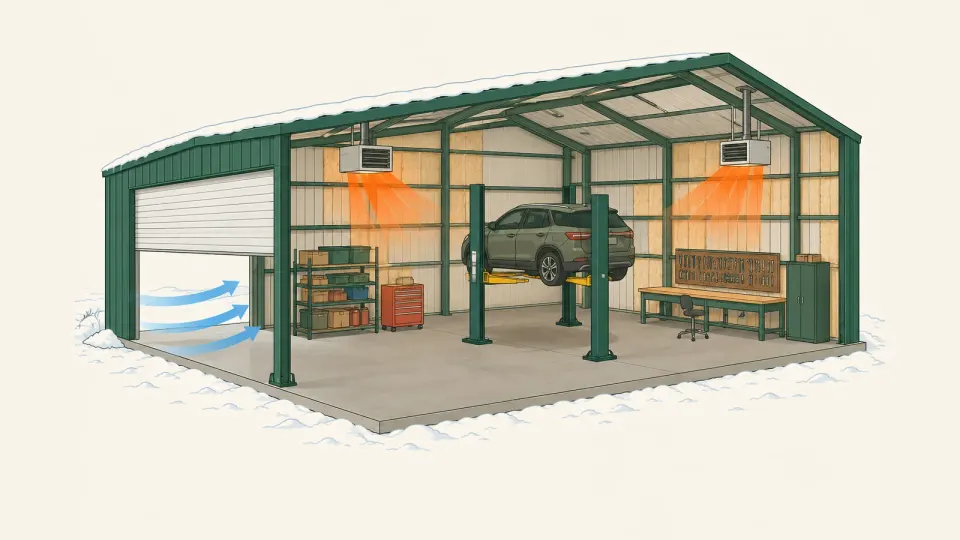
How the shop heater calculation works
Required output is length × width × height × insulation factor × indoor/outdoor temperature rise. All dimensions use feet and temperatures use Fahrenheit. The default 40 × 30 × 12 ft shop gives 14,400 cubic feet; 14,400 × 0.133 × 40 = 76,608 BTU/hr before rounding to 76,500. Fuel type changes shopping guidance, not heat loss.
Assumptions and limitations
Poor, average, good, and excellent insulation use factors 0.20, 0.133, 0.10, and 0.08. These represent the enclosure as a whole. They are not separately measured wall U-values or air-change rates. Bare metal, leaky roll-up doors, and high ceilings deserve particular care.
The tool estimates steady heating demand. It does not calculate individual wall, roof, slab, door, or infiltration losses, nor the warm-up energy of machinery and concrete. Destratification may improve comfort but is not a quantified capacity credit here. Large or unusual buildings need a professional load calculation; radiant tube layout requires manufacturer coverage and clearance guidance.
References and next steps
The methodology documents the planning factors and rounding. See King Electric's sizing guidance and DOE equipment-sizing guidance for context. Always check the installation manual of the unit you select.
Continue with running cost for the default shop, installation costs, the garage heater BTU chart, or the garage heater calculator for a house garage.
What makes a shop different from a garage
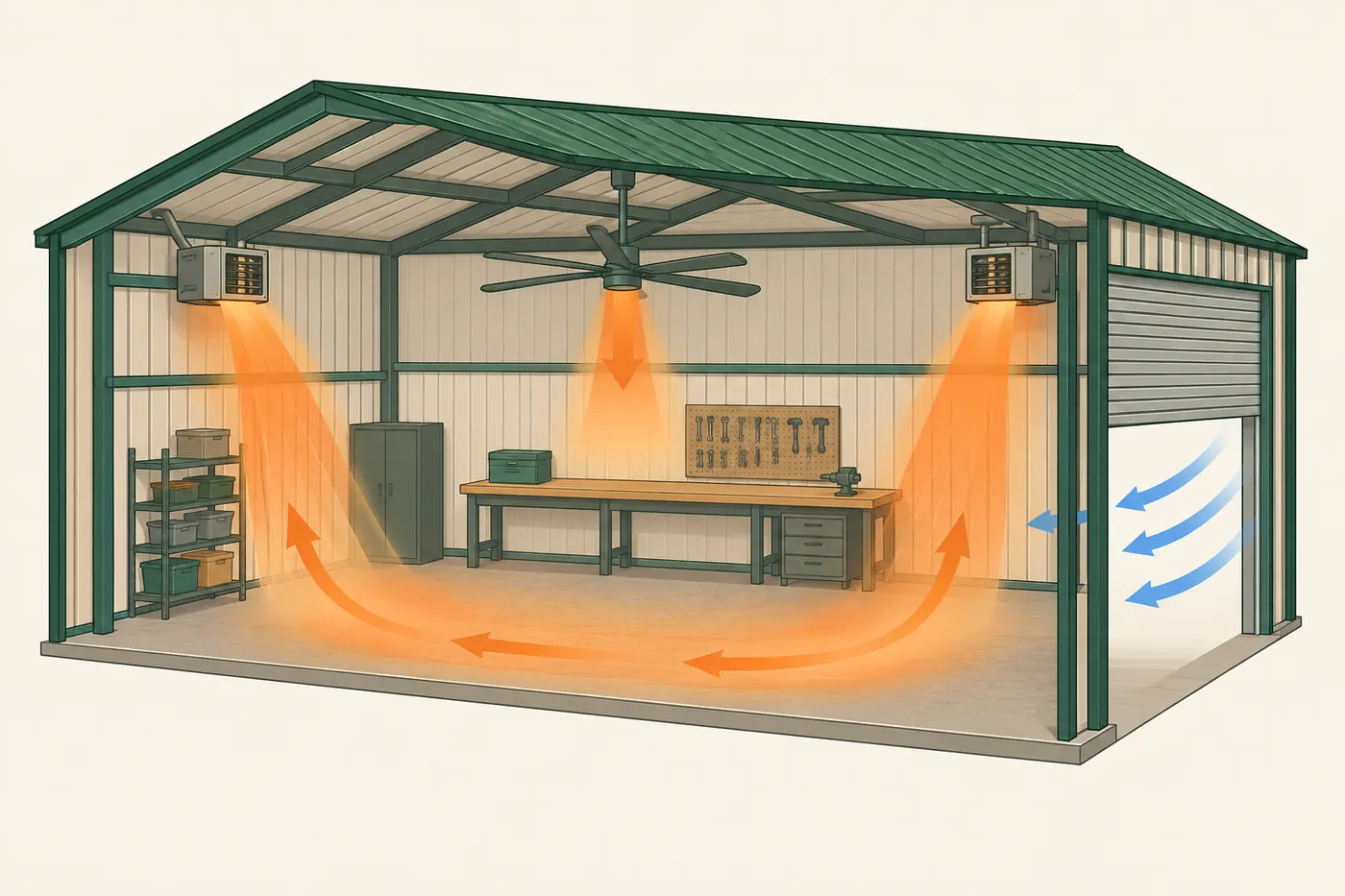
A shop usually has more air above your head. Tall ceilings add volume and let warm air collect at the roof, so a ceiling fan on low can bring useful heat back down and buy capacity back. Steel and pole construction without insulation loses heat faster than a house-attached garage, and large roll-up doors often dominate the heat loss.
Shops are also commonly heated on demand. If you start from cold for a project, slightly generous sizing shortens warm-up time. That does not mean buying twice the calculated capacity. It means using the real ceiling height, honest insulation setting, and coldest outdoor temperature before choosing the next standard unit size.
Common shop heater sizes
| Scenario | Size | Insulation | Rise | Heat needed | Electric | Gas input |
|---|---|---|---|---|---|---|
| 24 x 24 x 10, average insulation | 24 × 24 × 10 ft | Average | 40°F | 30,500 BTU/hr | 8,900 W | 45,000 BTU/hr |
| 30 x 40 x 12, average, mild winter | 30 × 40 × 12 ft | Average | 30°F | 57,500 BTU/hr | 16,900 W | 75,000 BTU/hr |
| 30 x 40 x 12, average, cold winter | 30 × 40 × 12 ft | Average | 40°F | 76,500 BTU/hr | 22,400 W | 100,000 BTU/hr |
| 30 x 40 x 12, bare metal, cold winter | 30 × 40 × 12 ft | Poor | 40°F | 115,000 BTU/hr | 33,700 W | 150,000 BTU/hr |
| 40 x 60 x 14, average, cold winter | 40 × 60 × 14 ft | Average | 40°F | 179,000 BTU/hr | 52,500 W | Multiple units |
When a shop enters gas territory
The 30 x 40 default needs about 76,500 BTU/hr delivered. At 80% efficiency, that is roughly 96,000 BTU/hr input, which in practice means a 100,000 BTU class gas unit heater. A 40 x 60 shop at about 179,000 BTU/hr usually takes two unit heaters. Two units spread heat along the building and avoid leaving a cold work area at the far end.
Electric heat makes sense for small, well-insulated shops. A 24 x 24 x 10 ft shop at excellent insulation and a 40°F rise lands near 5,400 W; confirm the circuit can support it. Most larger or uninsulated shops need more circuit capacity than that approach provides. In tall buildings, a radiant tube heater is another spot or zone option when people work in one part of the floor.
Insulate the shell before upsizing
Metal buildings reward envelope work. Liner insulation, spray foam, and fresh roll-up door seals can change the job before you buy equipment. Moving from the poor factor of 0.20 to the average factor of 0.133 cuts the required capacity by about 33%. That is a reduction in modeled capacity, not a measured annual fuel-saving percentage.
Use the methodology to understand the insulation factors, then compare your exact dimensions in the garage heater calculator or the shop tool above. The same heat-loss model applies to both spaces.
Pole barns and metal buildings
Pole barns are tall and often bare inside, so two inputs matter more than usual. First, use the real height to the underside of the roof, not the eave height on the brochure. Every extra foot adds volume, and warm air stacks up under the roof.
Second, rate the insulation by the weakest surface. Bare steel panels and an uninsulated roll-up door are poor, even if the walls have some batts. Faced liner insulation with sealed doors is closer to average. Spray foam on walls and roof with insulated doors earns good. The same 30 × 40 × 12 ft building needs about 115,000 BTU/hr bare and 76,500 BTU/hr at average.
Shop heater sizing questions
How many BTU do I need to heat a 30x40 shop?
About 76,500 BTU/hr delivered with average insulation and a 40°F rise; look for roughly a 100,000 BTU input gas unit heater at 80% efficiency. Bare metal without insulation pushes it to about 115,000 BTU/hr.
What size heater for a 40x60 shop?
About 179,000 BTU/hr delivered under the same conditions; two unit heaters usually beat one large unit on coverage.
Can I heat a shop with an electric heater?
Small, well-insulated shops are the most practical candidates. A 24 x 24 x 10 ft shop at excellent insulation and a 40°F rise needs about 5,400 W in this model. Larger or poorly insulated shops can exceed typical residential electric-heater capacity.
Do shop heaters list input or output BTU?
Gas and propane unit heaters list INPUT; at about 80% efficiency a 100,000 BTU input unit delivers about 80,000 BTU/hr. This calculator estimates required OUTPUT.