The Best Garage Heater for Your Garage Size and Fuel
Quick answer: For most two-car garages the best garage heater is a 7,500 W 240 V electric unit heater if you heat a few hours a week, or a 45,000 BTU input vented gas unit heater if you heat for long stretches. A 24 × 24 garage at average insulation needs about 24,500 BTU/hr when it is 20°F outside.
There is no single best heater, only the best one for your garage, fuel and hours. Answer six quick questions and the finder ranks every heater type by what it costs to buy, install and run in your garage. Picks come from our sizing model, not sales rankings, and there are no affiliate links.
Your garage
The best garage heater for each garage
Each garage is heated from 20°F outside to 60°F inside, with an 8 ft ceiling unless noted. The electric column is the smallest common 240 V size that covers the need; the gas column is input BTU at 80% efficiency.
| Garage | Heat needed | Electric | Gas or propane | Best pick |
|---|---|---|---|---|
| 1-car, 12 × 20 ft | 10,000 BTU/hr | 4,000 W | 30,000 BTU input | Electric. Even the smallest 240 V unit heater covers it. |
| 2-car, 24 × 24 ft | 24,500 BTU/hr | 7,500 W | 45,000 BTU input | Electric for a few hours a week; vented gas for long hours. |
| 2-car, 24 × 24 ft, uninsulated | 37,000 BTU/hr | Over 10 kW | 50,000 BTU input | Vented gas, or insulate first. It is past one 10 kW electric heater. |
| 3-car, 32 × 24 ft | 32,500 BTU/hr | 10,000 W | 45,000 BTU input | Vented gas if gas reaches the garage; otherwise one 10 kW electric heater. |
| Shop, 30 × 40 × 12 ft | 76,500 BTU/hr | Over 10 kW | 100,000 BTU input | Vented gas unit heater, or two smaller units for a long building. |
The 1-car garage needs only about 2,900 W, so a 4,000 W heater is enough; the King KB line below starts at 5,000 W. The shop needs about 76,500 BTU/hr, which no single electric garage heater supplies.
Best garage heater by fuel and how you use it
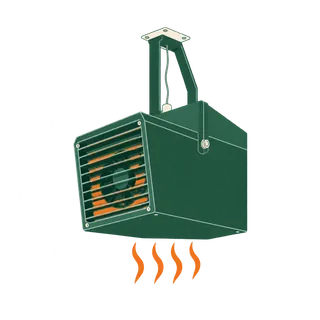 A few hours a week, no gas240 V electric unit heater
No vent and no fuel line; the install is one dedicated circuit. See electric garage heaters.
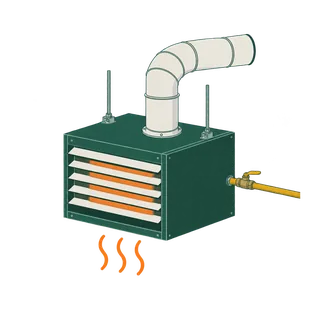 Long hours or a cold climateNatural gas unit heater (vented)
At 2025 U.S. average prices a delivered BTU from gas costs about a third of electric resistance heat. See natural gas garage heaters.
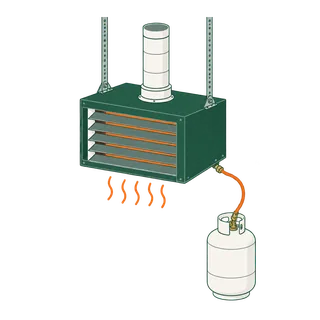 No natural gas, still want gas heatPropane unit heater (vented)
The same vented unit heaters run on propane from a tank. See propane garage heaters.
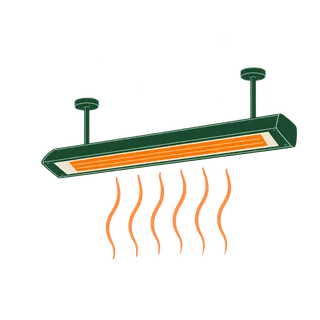 One workbench, not the whole garageElectric infrared heater
Warms you and the bench directly while the rest of the garage stays cool. Size one with the infrared garage heater sizing tool.
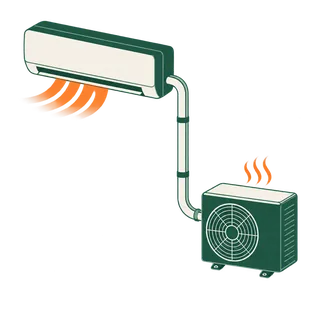 Heat in winter, cooling in summerDuctless mini split heat pump
Holds temperature cheaply but warms a cold garage slowly. Size one with the garage mini split calculator.
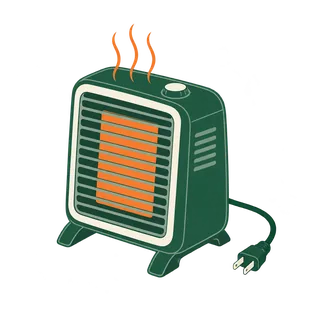 Taking the edge off a small space120 V plug-in heater
At 1,500 W it gives about 5,100 BTU/hr: fine for a bench, too small for a whole two-car garage in winter.
The best way to heat a garage guide ranks all six methods by what they would cost to run in your own garage.
Example models that match these sizes
These are examples of widely sold heaters in each size, with figures from each maker's own product page, checked November 7, 2026. They are not ranked and not tested by us. Models and part numbers change, so confirm the current spec sheet before you buy or wire anything.
Electric: King Electric KB series
A ceiling-hung, fan-forced 240 V unit heater line sold for garages and workshops. The coverage column is our estimate at average insulation, an 8 ft ceiling and a 40°F rise, not the maker's figure.
| Model | Rating | Amps at 240 V | Covers (our estimate) |
|---|---|---|---|
| King Electric KB2405-1-T-B1 | 5,000 W | 20.8 A | 400 sq ft |
| King Electric KB2407-1-T-B2 | 7,500 W | 31.3 A | 600 sq ft |
| King Electric KB2410-1-T-B2 | 10,000 W | 41.7 A | 800 sq ft |
Vented gas: Modine Hot Dawg and Mr. Heater Big Maxx
Modine's Hot Dawg power-vented unit heaters come in 30,000 to 125,000 BTU/hr input sizes with a 3 in vent through 75,000, and Modine quotes thermal efficiency up to 83%. In our model the 45,000 BTU size covers a typical two- or three-car garage and the 100,000 BTU size covers a 30 × 40 shop. The Mr. Heater Big Maxx 50,000 BTU natural gas utility heater is a vented 50,000 BTU input unit; at 80% efficiency it delivers about 40,000 BTU/hr, enough in our model for a three-car garage or an uninsulated two-car garage.
Why maker coverage claims run high
Mr. Heater says the 50,000 BTU Big Maxx “heats up to 1,667 sq. ft.” Our model gives about 940 sq ft at average insulation and a 40°F rise, and 1,250 sq ft with good insulation. The maker's figure lines up with a well-insulated garage held only 30°F above outside, which works out to about 1,670 sq ft in our model.
Neither number is wrong; they answer different winters. Box coverage figures usually assume a mild climate and a tight building. Size from your own coldest temperature and insulation, which is what the garage heater calculator does.
What to check before you buy
- Output, not input. Gas heaters are labeled by input. Multiply by the listed efficiency, or 80% if none is given, before comparing with what your garage needs.
- Vented. For a closed garage, choose power-vented or separated-combustion gas units.
- Circuit. A 240 V heater needs a dedicated circuit sized at 125% of its current: the 7,500 W size draws about 31.3 A at 240 V. See the wire size calculator.
- Mounting height and clearances. The manual sets them, and gas heaters in garages need their ignition source raised off the floor.
- Thermostat. A built-in or wall thermostat keeps a garage at a low holding temperature instead of running flat out.
- Fuel version. Natural gas and propane versions are different; check for a factory model or approved conversion kit.
What to avoid
A ventless gas or propane heater as the main heat in a closed garage: the exhaust stays in the room. An oversized heater bought “to be safe”: it short-cycles and costs more to install. A 120 V plug-in heater for a whole two-car garage in a cold winter: at 1,500 W it supplies about 5,100 BTU/hr against the 24,500 BTU/hr a typical 24 × 24 garage needs. A heater sized from a car count alone: an uninsulated two-car garage needs about 37,000 BTU/hr, half again as much as an average one.
Best garage heater questions
What is the best garage heater for a 2-car garage?
For a 24 × 24 × 8 ft garage at average insulation and 20°F outside, the garage needs about 24,500 BTU/hr. A 7,500 W 240 V electric unit heater covers it and is the cheapest to install; a 45,000 BTU input vented gas unit heater covers it with room to spare and costs less to run for long hours. See the 2-car garage heater size guide.
What is the best electric garage heater?
A hardwired 240 V fan-forced unit heater with a built-in or wall thermostat, sized from your garage rather than from the box. Plug-in 120 V heaters top out at 1,500 W, about 5,100 BTU/hr, which suits a workbench, not a whole two-car garage in winter.
What is the best gas garage heater?
A vented (power-vented or separated-combustion) unit heater sized by input BTU. At 80% efficiency a 45,000 BTU input unit delivers about 36,000 BTU/hr, enough for a typical three-car garage at average insulation.
Is a ventless heater the best choice for a garage?
Not as the main heater in a closed garage. Ventless gas and propane heaters release their exhaust, including carbon monoxide and water vapor, into the room. Read about ventless garage heaters.
How do I know what size garage heater I need?
Multiply the garage volume by an insulation factor and by the difference between your target and your coldest outdoor temperature. The calculator does it for you and shows both the steady heat loss and the output to shop for. Use the garage heater calculator.
Sources
Sources last checked November 7, 2026.
- King Electric, KB garage and unit heater (model table) (accessed November 7, 2026) · KB2405 / KB2407 / KB2410 kW and amps at 240 V
- Modine, Hot Dawg power-vented gas unit heater (accessed November 7, 2026) · sizes 30 to 125 MBH, thermal efficiency up to 83%
- Mr. Heater, 50,000 BTU Big Maxx natural gas utility heater (accessed November 7, 2026) · "Heats up to 1,667 sq. ft."
- EPA, Sources of Combustion Products (Dec 17, 2025)