Garage Mini Split Calculator
One unit that heats in winter and cools in summer. Enter your garage and coldest night to see the size that covers both, and what it costs to run.
Your garage
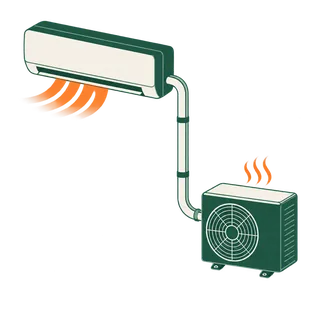
Mini split size to shop for
24,000 BTU (2 ton)
Winter heat sets the size: the garage loses about 14,200 BTU/hr at 20°F. Pick a model whose rated heating output at your winter low covers the heat loss.
Installed, single zone: $2,400–$5,500 (HomeAdvisor, June 2026).
Compare it in the best garage heater finder →Garage mini split sizes at a glance
Average insulation, 8 ft ceiling, kept at 60°F in winter. Each column is the smallest standard size that covers both summer cooling and winter heat at that low.
| Garage | Cooling need | 30°F low | 20°F low | 5°F low |
|---|---|---|---|---|
| 1-car, 12 × 20 ft | 6,000 BTU/hr | 9,000 BTU | 12,000 BTU | 18,000 BTU |
| 2-car, 24 × 24 ft | 14,000 BTU/hr | 18,000 BTU | 24,000 BTU | 30,000 BTU |
| 3-car, 32 × 24 ft | 18,000 BTU/hr | 24,000 BTU | 30,000 BTU | 36,000 BTU |
How the size is worked out
Cooling comes from the ENERGY STAR room air conditioner table, which gives capacity by floor area for an 8 ft ceiling. We add or remove 10% for a very sunny or heavily shaded garage, as ENERGY STAR suggests, and scale up for taller ceilings. Garages with a west-facing door or no insulation can run hotter than the table assumes.
Heating uses the garage's steady heat loss at your coldest night, from the same wall, door, ceiling, slab and air-leak model as the garage heater calculator, without the extra warm-up allowance a furnace-style heater gets. A heat pump runs for long stretches, so it is sized to hold temperature, not to blast a cold garage warm.
Heat pumps lose output as it gets colder. We assume the unit still delivers 70% of its rated heat at your low, the ENERGY STAR cold-climate minimum at 5°F. That is cautious for milder winters; a model's own capacity table at your temperature beats this rule.
Mini split or garage heater?
A mini split wins when the garage is heated for long hours, or when you also want summer cooling. A gas unit heater or a 240 V electric heater wins when you heat for short sessions from cold, because they warm the air in minutes. The best garage heater finder ranks all of them for your garage, and the warm-up simulator shows how long each takes to bring a cold garage up to temperature.
Questions people ask
What size mini split do I need for a 2-car garage?
For a 24 × 24 × 8 ft garage at average insulation, about 14,000 BTU/hr covers summer cooling, but winter decides the size: the garage loses about 14,200 BTU/hr at 20°F outside, which points to a 24,000 BTU unit if it keeps 70% of its rated heat at that temperature.
Is a mini split good for heating a garage?
For holding a steady temperature, yes: at a COP of 2.2 it uses less than half the electricity of a resistance heater, about $51 against $112 a month for our default 2-car garage. It is slow at warming a cold garage from scratch, so it suits garages kept heated, not ones heated for an hour on Saturday.
Can a mini split heat a garage in very cold weather?
Cold-climate models keep working below 0°F, but output falls as it gets colder. The ENERGY STAR cold-climate minimum is 70% of rated heat at 5°F. Below that, check the model's published capacity at your low, or keep backup heat.
Do I need to insulate the garage before adding a mini split?
It helps more than with any other heater, because a smaller, cheaper unit then covers the winter. Try Bare and Good insulation in the calculator above to see how much the size drops.
How much does a garage mini split cost to install?
A single-zone system typically runs $2,400 to $5,500 installed (HomeAdvisor, June 2026). It needs a dedicated circuit, a wall penetration for the line set, and a level pad or wall bracket for the outdoor unit.
Sources
Sources last checked November 7, 2026.
- ENERGY STAR, Room Air Conditioners (sizing table) (accessed November 7, 2026) · capacity by floor area at an 8 ft ceiling; ±10% for shade or sun
- EPA, ENERGY STAR cold climate heat pump verification memo (draft, 2020) · COP 1.75 and 70% of 47°F capacity at 5°F
- ENERGY STAR, Ductless Heating & Cooling (undated) · garages and outbuildings as a use case
- HomeAdvisor, Ductless Heat Pump Cost (June 20, 2026) · single zone $2,400 to $5,500 installed